“Meditation is a way of being, not a technique.” ~Jon Kabat-Zinn
I didn’t think I was someone who “couldn’t meditate.”
I had read the books. I understood the benefits. I knew, intellectually, that sitting with my breath was supposed to help me feel calmer, more present, more myself.
And yet every time I tried, something inside me tightened.
My mind raced. My body felt exposed. Stillness didn’t feel peaceful—it felt like being left alone with something that didn’t know how to hold me.
So I stopped trying.
For a long time, I assumed this meant there was something wrong …
“Meditation is a way of being, not a technique.” ~Jon Kabat-Zinn
I didn’t think I was someone who “couldn’t meditate.”
I had read the books. I understood the benefits. I knew, intellectually, that sitting with my breath was supposed to help me feel calmer, more present, more myself.
And yet every time I tried, something inside me tightened.
My mind raced. My body felt exposed. Stillness didn’t feel peaceful—it felt like being left alone with something that didn’t know how to hold me.
So I stopped trying.
For a long time, I assumed this meant there was something wrong with me. That I lacked discipline. That I hadn’t tried hard enough. That everyone else had learned how to be present, and I’d somehow missed the lesson.
Then one afternoon, without meaning to, I did something that changed my relationship with attention entirely.
A Moment That Didn’t Ask Anything of Me
I was outside on a familiar path in the park near my home, walking without much awareness. It was late afternoon, one of the rare moments when my husband had taken over with the kids, and my body still felt overstimulated from the day.
It had been a difficult season—the kind where you don’t feel dramatic sadness so much as a low, persistent fatigue.
I was burned out from early motherhood, caring for young children without much of a village, moving through my days with no quiet place to land. The world felt loud. My inner world felt thin.
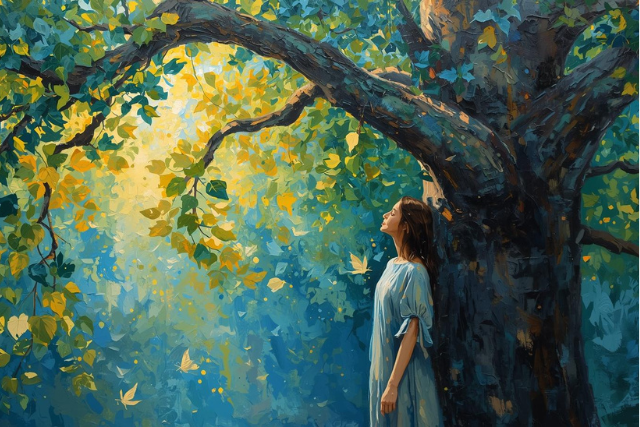
I stopped near a tree and noticed a leaf. Nothing special about it. Just a leaf. But something in me paused.
I stayed there longer than expected, watching the way the light touched its surface, the fine lines branching outward, the way it moved slightly in the air.
I wasn’t trying to concentrate. I wasn’t trying to calm myself. I wasn’t correcting my thoughts or following my breath.
I was just looking.
And somewhere in that looking, something softened.
Not in a dramatic way. There was no insight I could name. But I felt myself arrive—in my body, in the moment—without effort.
When I eventually moved on, I noticed my shoulders had dropped. My breathing had slowed. The quiet vigilance I usually carried had loosened, just a little.
It stayed with me.
Why This Felt Different
I began to notice that this kind of attention—spontaneous, gentle, outward—felt different from the practices I had struggled with before.
Sitting still with my eyes closed asked me to turn inward before I felt ready.
Being in nature asked nothing. It simply offered something to meet.
I didn’t have to hold myself together. The world was already doing that.
Over time, these moments multiplied.
A patch of moss. The sound of water. The quiet satisfaction of noticing what was ripe and what wasn’t while foraging. Walking without a destination. Stopping without guilt.
My attention wandered and returned on its own.
I began to understand something I hadn’t before: for some of us, presence doesn’t begin inside.
It begins in relationship.
When Attention Is Invited, Not Demanded
When attention is invited rather than demanded, the body responds differently.
With movement, texture, and choice, there’s less pressure to perform calm or get it right. Attention feels accompanied rather than examined.
What I had once labeled resistance to meditation began to look like something else—a part of me that didn’t yet trust stillness.
Nature showed me that calm doesn’t always come from discipline.
Sometimes it comes from being met—by light, texture, or movement that can hold attention gently. Once that sense of ease is there, attention follows naturally.
What Changed When I Stopped Trying to Be Present
At first, the changes were easy to miss.
Nothing about my life looked dramatically different. I wasn’t suddenly serene or grounded in every situation. I still had anxious days. I still overthought things.
But something subtle shifted.
One evening not long after, I noticed it while talking with my husband. A familiar tension rose in my chest, the urge to fix something quickly. Instead of pushing through it, I paused. I let the moment breathe. The conversation softened on its own, and I realized I hadn’t been bracing in the way I usually did.
I noticed that my attention no longer snapped back to me so quickly. I wasn’t constantly monitoring how I was doing—whether I was present enough, relaxed enough, doing it right.
When I walked, I walked. When I stopped, I stopped.
There was less commentary running in the background.
I also began to feel moments of pleasure without immediately scanning for danger—a shaft of light through branches, the smell of damp earth, the quiet satisfaction of finding something edible and ripe.
These moments didn’t trigger the familiar urge to analyze or explain them away.
They were allowed to be enough.
Over time, I realized that what I was practicing wasn’t focus.
It was trust.
Trust that attention could move on its own. Trust that my body knew how to settle when it felt supported. Trust that I didn’t need to supervise every inner state.
This began to carry into other areas of my life. I paused more before reacting. I let silence stretch a little longer in conversations. I noticed when I was pushing myself unnecessarily—and sometimes chose not to.
Presence stopped feeling like something I had to manufacture.
It became something I could recognize when it arrived.
When Nature Didn’t Help
There were also days when this didn’t work.
Days when being outside felt flat or distant. When I wandered without really arriving anywhere. When the quiet felt foggy rather than soothing.
At first, I worried I was failing again.
But over time, I learned to read these moments differently.
They weren’t mistakes. They were signals.
Sometimes what I needed wasn’t more openness, but more grounding—movement instead of stillness, a faster walk, something solid under my hands.
And sometimes, nature wasn’t enough.
Those moments reminded me that this practice isn’t a replacement for human connection or deeper personal work. It’s a support, not a solution to everything.
Learning to notice the difference mattered.
Presence has a texture to it—a sense of contact. When that texture was missing, the invitation wasn’t to push harder, but to slow down further or reach out rather than retreat.
A Different Kind of Stillness
I used to believe that presence was something you achieved through effort.
That if I could just sit long enough, breathe correctly, or stop my thoughts from wandering, something would finally settle.
What I’m learning instead is that presence often arrives as a response.
In nature, nothing asks us to perform calm. Nothing corrects us when our focus drifts.
We’re allowed to look away. To move. To come back in our own time.
For some of us, turning inward too quickly can feel exposing. Being asked to “just sit with it” can land as another demand to manage ourselves alone.
Being with a tree, a stone, or a stretch of ground creates a different experience.
Attention has somewhere to land. There’s something steady that doesn’t evaluate or disappear.
The body learns, slowly, that it can stay without bracing.
An Invitation, not a Technique
If stillness has ever felt unsettling rather than calming, it may not mean you’re doing anything wrong.
It may simply mean you need a different doorway.
You might try this:
Go outside. Let your attention rest on one small, ordinary thing. Don’t analyze it or hold it tightly. Just stay long enough to notice if something softens, even slightly.
You don’t need to meditate longer.
You might just need to linger.
With something that doesn’t rush you. With something that stays.
And let yourself be changed—slowly—by what meets you there.
About Mina Todorova
Mina writes about healing, nervous system regulation, and personal growth on her blog fromcentowholeness.com. Most posts include simple, supportive free guides to help you apply the insights. Explore topics like emotional healing, mindful living, gentle parenting, and seasonal self-care. To support your rest journey, download her free worksheet “Learning to Feel Safe in Stillness” here.
Get in the conversation! Click here to leave a comment on the site.
Recommended Story For You :

Discover the Obsession Method and Transform Your Relationships

Unveiling the Secrets to Rekindle Your Relationship and Get Your Girlfriend Back

Unlocking the Secrets of Water Harvesters for Sustainable Solutions

Your Trusted Guide to Practical Medicine for Every Household

Discover the Obsession Formula for Magnetic Connections
Transforming a Connection into a Lasting Relationship with One Simple Move
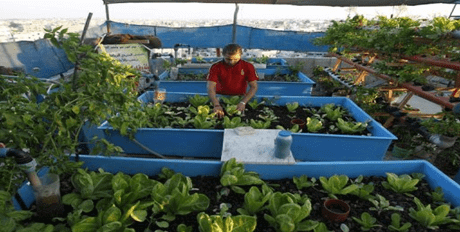
The High Output Pocket Farm – Cultivating Life amidst Desert War Zones

EVERYTHING IS HAPPENING THE EXACT TIME AND IN THE EXACT ORDER

Leave a Reply